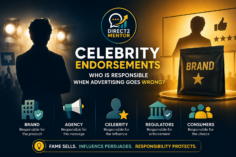
A celebrity can make a product famous. An advertising agency can make it attractive. But who makes sure the message is responsible?
The recent controversy around the Vimal Elaichi advertisement has brought this question back into the spotlight. Maharashtra FDA has issued show-cause notices to Shah Rukh Khan, Ajay Devgn and Tiger Shroff over the advertisement, alleging that it could amount to surrogate promotion of Vimal Pan Masala.
But this isn’t really about three actors.
It is about a much bigger question:
Who is responsible when advertising crosses the line?
What is the responsibility of an advertising agency?
A good advertising agency shouldn’t simply take whatever a client says and turn it into a catchy advertisement.
If a client says, “Our product gives 100% results,” the agency should ask:
“Can you prove it?”
If the claim is about health, safety, performance or quality, some basic due diligence is essential.
For example, if a water-purifier company wants to advertise that its system provides bacteria-free water, a responsible agency should ask for supporting laboratory reports before making that claim.
But there is also a limit to the agency’s responsibility.
If the agency has reasonably verified the claim and, six months later, the manufacturer has a problem with a particular batch, the agency cannot automatically be blamed for a manufacturing failure.
The agency is responsible for the communication it creates. It isn’t automatically responsible for everything that happens to the product after the advertisement is made.
And what about celebrities?
This is where things become more complicated.
A celebrity isn’t just another person appearing in an advertisement.
Millions of people follow them.
Fans copy their clothes, hairstyles and sometimes even their lifestyle choices.
So when a celebrity puts their name and face behind a product, they are lending something more valuable than their appearance:
their influence.
And influence comes with responsibility.
In fact, ASCI’s guidelines require celebrities to undertake due diligence to ensure that claims and representations in advertisements they endorse can be objectively substantiated and are not misleading.
That doesn’t mean a celebrity has to become a scientist, lawyer or product expert before accepting every advertisement.
But asking a few basic questions seems reasonable:
What exactly am I endorsing?
What claims am I making?
Can those claims be supported?
Could this advertisement be encouraging something harmful?
Would I be comfortable if millions of my followers acted on my recommendation?
That last question is perhaps the most important.
Surrogate advertising makes the issue even more complicated
There is another uncomfortable reality in advertising.
Sometimes the industry becomes very good at finding loopholes.
A restricted product may not be advertised directly, but a related product carrying the same brand identity is promoted instead.
Technically, the communication may be presented as something else.
But the real question is:
What does the consumer actually remember?
If consumers see a brand repeatedly associated with a particular product category, does advertising a different product under the same brand name effectively keep the original product in their minds?
That is precisely why surrogate advertising remains such a controversial issue.
And this is where agencies need to ask more than:
“Can we do this?”
They should also ask:
“Should we do this?”
But are celebrities responsible for everything they promote?
No.
We also need to be fair.
A celebrity cannot be expected to independently investigate every aspect of a company’s manufacturing, finances, supply chain and business operations.
Responsibility has to be shared.
The manufacturer is responsible for the product.
The brand is responsible for the claims it makes.
The advertising agency is responsible for the communication it creates.
The celebrity has a responsibility to exercise appropriate due diligence before putting their influence behind the product.
And regulators have a responsibility to create and enforce clear rules.
But there is one more person in this chain.
The consumer.
Don’t confuse popularity with expertise
This is perhaps the biggest lesson for all of us.
We admire an actor for acting.
We admire a cricketer for cricket.
We follow an influencer because we enjoy their content.
But none of that automatically makes them an expert on the product they are promoting.
A famous actor recommending a product doesn’t make that product scientifically superior.
A cricketer promoting an investment doesn’t make it a good investment.
A celebrity wearing something doesn’t necessarily make it the best product in that category.
Popularity is not expertise.
And a celebrity endorsement should never replace our own judgment.
Advertising is powerful. That’s why responsibility matters.
Advertising is supposed to persuade.
That’s its job.
But persuasion should not become manipulation.
An advertising agency can make a product look desirable.
A celebrity can make it familiar.
A huge media campaign can make it impossible to ignore.
But somewhere in that chain, someone has to stop and ask:
Is this communication honest, responsible and fair to the consumer?
That is the real lesson from controversies like this.
Not simply “Which celebrity is at fault?”
Not simply “Which agency created the advertisement?”
But:
What responsibility does each person in the advertising ecosystem have?
Because being legally allowed to do something and being comfortable defending it ethically are not always the same thing.
And perhaps responsible advertising begins when we stop asking only:
“Can we advertise this?”
and start asking:
“Should we?”